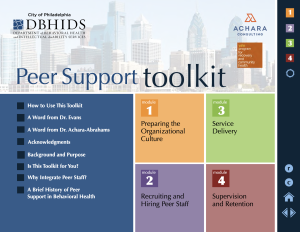
Avant l’embauche (pages 22-23)
- Planifier le mode de financement et la présentation du programme dans l’institution — Englander et al. (2020)
- Définir clairement le rôle et le cahier des charges, en prévoyant des temps de repos suffisants — Ehrlich et al. (2020) ; Launay & Maugiron (2017)
- Préciser les compétences attendues et l’approche théorique du programme — Stack et al. (2022) ; Tracy et al. (2011)
- Engager si possible plusieurs PAs aux profils variés (genre, âge, origine ethnique, personnalité, type de substance, troubles concomitants) pour correspondre à la diversité des patients — Walde et al. (2023)
- Aborder la discrimination et la stigmatisation au niveau systémique dès le départ, et reconnaître formellement le rôle au niveau salarial — Stack et al. (2022)
Processus d’embauche (page 23)
- Favoriser les candidats avec qui le contact passe bien, enthousiastes, ayant une perception positive des soins et capables d’utiliser leur parcours de rétablissement comme outil — Launay & Maugiron (2017)
- Adopter un processus collaboratif et structuré — Englander et al. (2020)
Quatre étapes clés selon Crisanti et al. (2022) (page 23) :
- Embaucher un PA bien adapté au service
- Former le personnel sur la valeur et le rôle des pairs
- Établir des protocoles de flux de travail
- Fournir formation et supervision appropriées aux pairs
Supervision (pages 23-24)
- Hebdomadaire, formelle, axée sur le rétablissement — Stack et al. (2022)
- Le superviseur doit avoir une expérience avec les personnes en rétablissement et tenir compte des traumatismes liés aux addictions — Stack et al. (2022)
- La supervision peut être assurée par un pair plus expérimenté et/ou par co-supervision clinicienne — Byrne et al. (2023)
- Il arrive que le superviseur co-anime des ateliers avec les pairs — Tracy et al. (2011)
- En l’absence de supervision formelle, deux soignants référents peuvent favoriser l’intégration du pair — Launay & Maugiron (2017)
Intégration dans l’équipe (pages 23-24)
Anticiper et discuter les changements de posture qu’apporte l’arrivée d’un pair, créer un espace pour exprimer doutes et craintes — Launay & Maugiron (2017)
Le pair doit être présent aux réunions de synthèse, et non fonctionner seul de son côté — Launay & Maugiron (2017)
Prévoir une phase d’observation initiale pour se familiariser avec le service, l’équipe et les patients, avant de co-animer progressivement des groupes thérapeutiques — Launay & Maugiron (2017) ; Ehrlich et al. (2020)
Sources
Byrne, K., Pericot-Valverde, I., Stevens, M., Melling, T., Jones, R., & Litwin, A. (2023). Evolution of the assertive community engagement model for peer recovery coaching informed by the assertive community treatment model. ADDICTION RESEARCH & THEORY. https://doi.org/10.1080/16066359.2023.2176847
Collins, D., Alla, J., Nicolaidis, C., Gregg, J., Gullickson, D. J., Patten, A., & Englander, H. (2019). "If It Wasn't for Him, I Wouldn't Have Talked to Them": Qualitative Study of Addiction Peer Mentorship in the Hospital. Journal of General Internal Medicine. https://doi.org/10.1007/s11606-019-05311-0
Crisanti, A., Earheart, J., Deissinger, M., Lowerre, K., & Salvador, J. (2022). Implementation Challenges and Recommendations for Employing Peer Support Workers in Emergency Departments to Support Patients Presenting after an Opioid-Related Overdose. INTERNATIONAL JOURNAL OF ENVIRONMENTAL RESEARCH AND PUBLIC HEALTH, 19(9). https://doi.org/10.3390/ijerph19095276
Ehrlich, C., Slattery, M., Vilic, G., Chester, P., & Crompton, D. (2020). What happens when peer support workers are introduced as members of community-based clinical mental health service delivery teams: A qualitative study. Journal of Interprofessional Care, 34(1), 107–115. https://doi.org/10.1080/13561820.2019.1612334
Englander, H., Gregg, J., Gullickson, J., Cochran-Dumas, O., Colasurdo, C., Alla, J., Collins, D., & Nicolaidis, C. (2020). Recommendations for integrating peer mentors in hospital-based addiction care. Substance Abuse, 41(4), 419–424. https://doi.org/10.1080/08897077.2019.1635968
Francia, L., Berg, A., Lam, T., Morgan, K., & Nielsen, S. (2023). "The peer workers, they get it"—How lived experience expertise strengthens therapeutic alliances and alcohol and other drug treatment-seeking in the hospital setting. ADDICTION RESEARCH & THEORY, 31(2), 106–113. https://doi.org/10.1080/16066359.2022.2124245
Launay, C., & Maugiron, P. (2017). Integration of a peer support worker to a psychiatric healthcare team: The role and its functions. ANNALES MEDICO-PSYCHOLOGIQUES, 175(8), 741–746. https://doi.org/10.1016/j.amp.2017.08.002
Stack, E., Hildebran, C., Leichtling, G., Waddell, E. N., Leahy, J. M., Martin, E., & Korthuis, P. T. (2022). Peer Recovery Support Services Across the Continuum: In Community, Hospital, Corrections, and Treatment and Recovery Agency Settings—A Narrative Review. Journal of Addiction Medicine, 16(1), 93–100. https://doi.org/10.1097/ADM.0000000000000810
Tracy, K., Burton, M., Nich, C., & Rounsaville, B. (2011). Utilizing peer mentorship to engage high recidivism substance-abusing patients in treatment. The American Journal of Drug and Alcohol Abuse, 37(6), 525–531. https://doi.org/10.3109/00952990.2011.600385
Walde, P., Hadala, J., Peipe, V., & Völlm, B. A. (2023). Implementation of a peer support worker in a forensic psychiatric hospital in Germany-Views of patients. Frontiers in Psychiatry, 14, 1061106. https://doi.org/10.3389/fpsyt.2023.1061106